
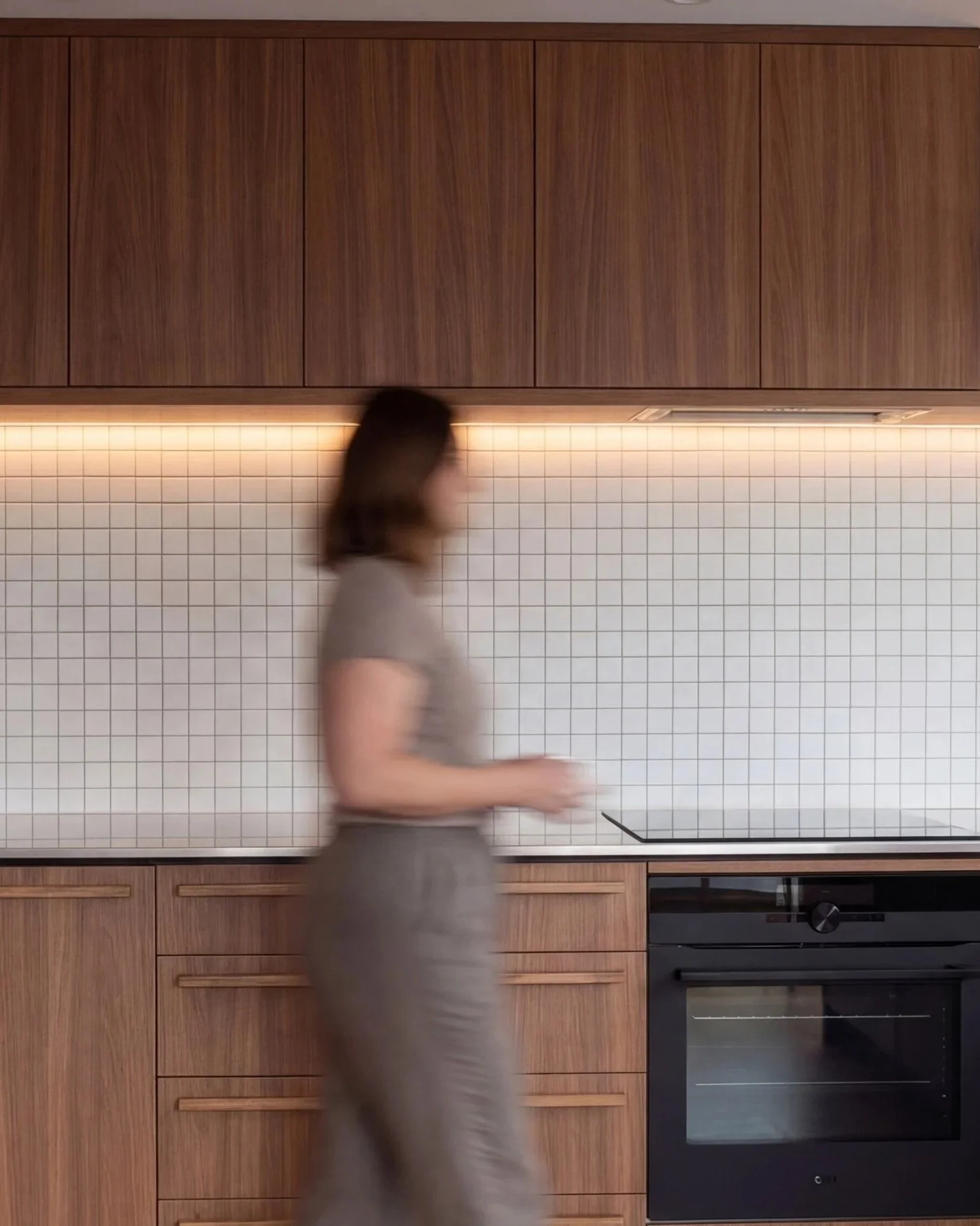
What is joinery-first kitchen design?
Joinery-first kitchen design means you start with storage, workflow, and how your household moves through the room, before you choose colours, finishes, or even appliances.
The joinery layout is designed around real life, then everything else supports that.
What joinery actually is
Joinery is the built structure of your kitchen. Cabinets, drawers, pantry units, benchtops, panels, shelves, appliance housings, and even the kickboards all sit in this bucket.
It is not just “cupboards.” It is the carcasses you never see, the hinges and runners you barely notice, and the clearances that let doors and drawers open without clashing. Good joinery treats the kitchen as a hard working machine, not just a pretty picture.
How most kitchens get designed now
Most kitchens are designed around what is being sold. A cabinet range. A benchtop surface. A display seen in a showroom. The plan is often drawn to fit standard cabinet sizes, then your life is made to fit inside that.
Common results:
Bins nowhere near the main prep zone
Nowhere that actually fits lunchboxes or small appliances
Fridge and pantry doors that collide
Islands that sit in the way of the main path through the room
On paper it looks fine. In daily use it feels slightly off every single day.
What a joinery-first process looks like
Joinery-first flips the order.
Before any finish is chosen, the design process maps:
1. Workflow zones
Where food comes in, where it is stored, where it is prepped, cooked, served, and cleaned. Each zone needs enough bench space and the right storage around it.
2. Storage logic
What lives in the kitchen and how often you use it. Everyday plates and glasses at arm height. Heavy appliances in drawers near where you use them. Kid lunch gear at kid height if you have children.
3. Internal layout of every cabinet
Drawers and shelves are sized to their contents. Pot drawers to actual pots. Bin drawers to the right bin sizes. Corner units chosen for how you will reach into them.
4. Traffic flow
How many people use the kitchen at once. Where people enter from. Whether the cook can work without constant collisions. The layout is drawn to suit that pattern, not a generic “triangle.”
Only when those four pieces work on paper does the design move to profiles, colours, handles, benchtop material, and feature finishes.
Why this changes how the kitchen feels
When every drawer and cabinet has a clear job, you stop thinking about where things go. They simply have a place. Morning and evening routines feel smoother because the kitchen supports the way you move, instead of fighting it.
You also get more from the same footprint. Custom or well considered joinery uses awkward corners, ceiling height, and narrow gaps that standard cabinets leave as dead space. That extra storage takes pressure off benchtops and open shelves.
Visually, a joinery-first kitchen often looks calmer. There is less clutter on display because more has a home behind doors and drawers.
Who joinery-first design is best for
Joinery-first design suits:
Busy households that cook most days
Families with more than one person in the kitchen at once
Renovations in older homes with awkward corners or tight spaces
Anyone who has lived with a “pretty but annoying” kitchen and does not want to repeat that
It matters less for very low use kitchens or short term rentals. For your main family kitchen, it is usually the difference between “nice” and “this actually works for us.”
If you want your next kitchen designed around how you live, not just how it looks, the first step is a conversation.
Design is about 10% of your spend, but it protects the other 90%
The decisions made at this stage are what keep the build on time and on budget.